

AI Cash Flow Forecasting for Startups: Predict Runway Faster
AI cash flow forecasting helps startup founders and CFOs turn bank, accounting, payroll, billing, and revenue data into continuously updated projections. It can reduce spreadsheet maintenance, identify unusual transactions, explain variances, and model runway scenarios faster. It cannot correct incomplete data, unrealistic assumptions, inconsistent financial definitions, or poor management judgment.
For a startup, the central question is not simply whether revenue is growing. It is whether the company will have enough cash to fund payroll, suppliers, product development, debt obligations, and other commitments until the next financing or collection cycle.
New to financial operating systems? Start with our Financial Operating System 101 guide.
What is AI cash flow forecasting?
AI cash flow forecasting combines connected financial data, deterministic cash calculations, statistical forecasting, machine learning, and human-defined assumptions to estimate future inflows, outflows, cash balances, and runway. AI is most useful for classification, pattern detection, anomaly monitoring, variance explanations, and scenario analysis. The underlying arithmetic should remain transparent and reproducible.
Cash flow forecasting is different from profit forecasting. Profit is an accounting measure that may include non-cash items and accrual timing. Cash flow tracks when money actually enters or leaves the business. A company can report revenue or accounting profit while facing a near-term cash shortfall because customers have not paid, inventory has increased, or large obligations are due.
The U.S. Small Business Administration recommends cash-flow projections as part of business planning. The Federal Reserve’s Small Business Credit Survey also consistently identifies financial challenges and access to capital as important operating concerns for small businesses.
How is AI cash flow forecasting different from ordinary automation?
AI forecasting interprets financial data in addition to moving it between systems. Traditional automation can import transactions, refresh formulas, or reconcile records. AI-assisted forecasting can classify transactions, detect changes in spending or collections, identify recurring patterns, summarize why a forecast moved, and compare alternative assumptions.
Neither approach removes the need for controls. A reliable forecast should show its source data, assumptions, calculation logic, confidence limits, and actual-versus-forecast performance.
Why does cash flow forecasting matter for startups?
Cash flow forecasting matters because startups often have volatile revenue, concentrated customers, long sales cycles, rapid hiring plans, and limited financial reserves. A rolling forecast connects those operating decisions to liquidity. It shows when cash may fall below a defined reserve and how much time management has to respond.
For solo founders, forecasting creates a repeatable operating rhythm instead of a last-minute spreadsheet exercise. For CFOs, it connects the operating plan with board reporting, capital planning, hiring decisions, fundraising, and risk management.
How does forecasting help manage startup runway?
Runway is the estimated time until available cash reaches a defined minimum balance. The simplest formula is:
Runway in months = Cash available ÷ Average monthly net burn
This formula is useful for a quick estimate, but it can mislead when collections, hiring, annual contracts, debt payments, taxes, or financing proceeds have unusual timing. A monthly cash model should therefore show expected inflows and outflows by period rather than relying only on average burn.
Most startups should monitor at least three cases:
- Base case: The most supportable operating plan.
- Downside case: Slower sales, delayed collections, higher costs, or delayed fundraising.
- Upside case: Faster growth or better retention, without treating optimistic assumptions as guaranteed cash.
Runway should also be measured against a minimum operating reserve. A cash-zero date is not necessarily the date when management should act; waiting until the balance reaches zero leaves no room for execution delays or unexpected obligations.
How does forecasting improve hiring decisions?
A hiring decision should be modeled as a total cash commitment, not only as annual salary. The forecast should include wages, payroll taxes, benefits, recruiting costs, equipment, commissions, and the delay before the employee contributes revenue or productivity.
AI can compare hiring now, hiring later, using a contractor, or setting a revenue-based hiring trigger. The output informs the decision; it does not make the strategic, cultural, or product judgment for the founder or leadership team.
How does forecasting support fundraising?
A fundraising forecast shows how much capital the company needs, when it needs it, and which milestones the financing is expected to fund. Investors typically examine assumptions involving growth, gross margin, customer acquisition, retention, hiring, and cash consumption.
A credible fundraising model should include:
- Opening cash and committed financing.
- Monthly revenue and collection assumptions.
- Headcount and operating expense plans.
- Gross and net burn.
- Base, downside, and upside scenarios.
- Monthly cash balance and runway.
- Milestones associated with the next financing.
- Financing proceeds and relevant repayment or conversion terms.
The National Venture Capital Association’s model legal documents illustrate how financing terms can create obligations that affect a company’s cash planning. Fundraising should therefore be modeled as a financing event with assumptions and conditions—not simply as free cash.
How does an AI financial forecasting system work?
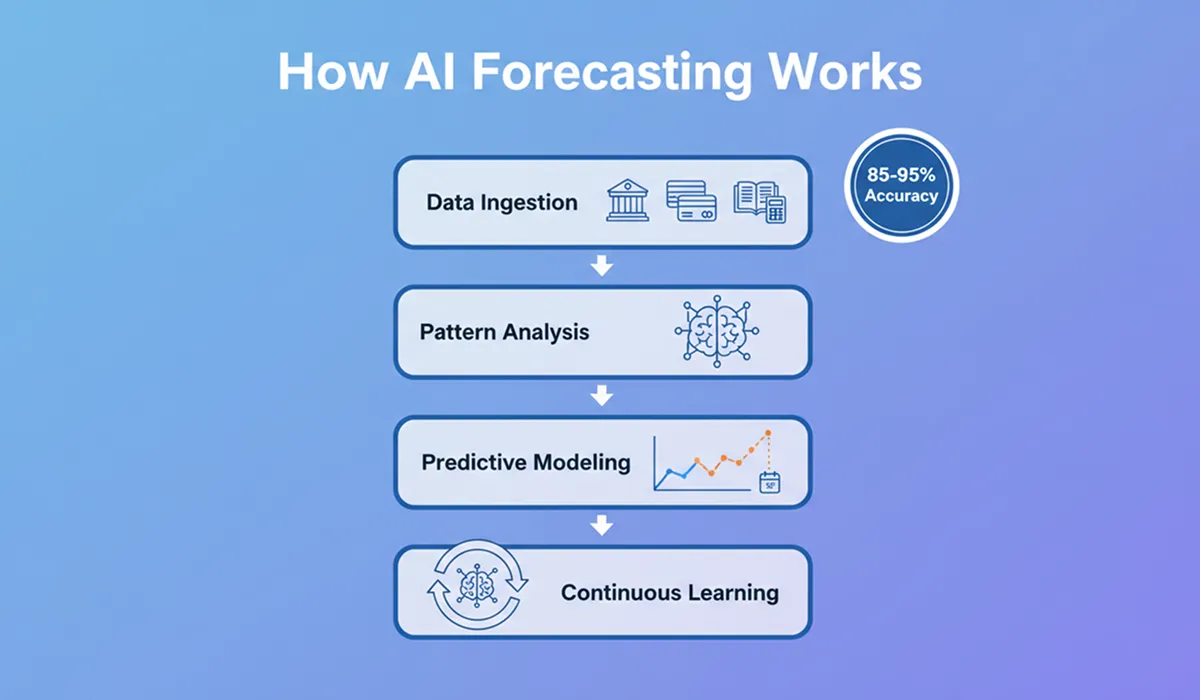
An AI financial forecasting system usually connects financial sources, standardizes transactions, applies rules and forecasting methods, and compares projections with actual results. The most dependable architecture uses software for balances and arithmetic while AI assists with classification, interpretation, anomaly detection, and natural-language explanations.
What happens during data ingestion?
The system gathers information from sources such as:
- Bank accounts and credit cards.
- Accounting platforms such as QuickBooks or Xero.
- Payment processors such as Stripe or PayPal.
- Payroll and human resources systems.
- Billing, subscription, and customer relationship management tools.
- Debt, lease, and financing schedules.
Connected data is valuable only when transactions are mapped consistently. Duplicate records, missing payment dates, uncategorized expenses, and inconsistent revenue definitions can distort a forecast regardless of the model’s sophistication.
What happens during data normalization?
Normalization converts raw transactions into consistent categories and time periods. It may separate recurring revenue from one-time revenue, classify payroll correctly, identify intercompany transfers, and distinguish cash timing from accounting recognition.
The finance team should document:
- Revenue categories and recognition rules.
- Fixed, variable, step, discretionary, and one-time expenses.
- Recurring versus non-recurring costs.
- Accounts receivable and accounts payable timing.
- Planned hires and contract changes.
- Unusual or non-operating transactions.
A forecast that changes definitions from month to month may appear precise while becoming less useful for trend analysis.
What happens during forecasting?
Forecasting uses historical data, explicit assumptions, and selected statistical or rules-based techniques to estimate future outcomes. Depending on the company and available history, a system may use time-series models, regression, cohort analysis, driver-based logic, or simulations.
A useful forecast produces ranges and scenarios rather than one unsupported point estimate. Saying that cash will be exactly $412,000 on a future date creates false precision. A better forecast identifies the assumptions, likely range, and variables most likely to change the result.
How does the system learn from actual results?
A rolling forecast improves through variance analysis: comparing projected results with actual results and determining why they differ. The cause may be a faulty assumption, a timing difference, a data error, or a genuine business change.
A practical review asks:
- Which revenue assumptions were wrong?
- Which expenses were unexpected?
- Were payments earlier or later than expected?
- Did a one-time event distort the period?
- Should the assumption change, or should the variance remain isolated?
Which metrics should AI forecasting monitor?
An effective startup forecast connects cash metrics with operating metrics. Cash indicates when liquidity may become constrained; operating metrics help explain why. The appropriate metric set depends on the company’s business model, billing terms, sales cycle, headcount plan, and financing structure.
What should a startup cash flow forecast include?
At minimum, a cash forecast should include opening cash, collections, payroll, vendors, taxes, debt service, financing activity, closing cash, the minimum reserve, and the cash-zero date under each scenario. The model should distinguish expected cash timing from accounting revenue and expenses.
For invoice-based businesses, collections may matter more than bookings. For subscription businesses, renewal timing, failed payments, churn, expansion revenue, and payment terms can materially affect cash.
How should founders measure burn?
Gross burn is total cash spending during a period. Net burn is cash spent minus cash generated from operations. Both metrics are useful:
- Gross burn: Shows the scale of spending.
- Net burn: Shows how quickly operating cash is being consumed.
- Burn trend: Shows whether spending is accelerating or slowing.
- Burn multiple: Connects net burn with net new recurring revenue.
A common formula is:
Burn multiple = Net burn ÷ Net new recurring revenue
The company should define the formula consistently. A single month can be distorted by annual contracts, hiring cycles, or delayed collections, so founders should compare monthly results with a trailing average.
Which revenue metrics should be forecast?
Revenue forecasting may include:
- Monthly recurring revenue.
- Annual recurring revenue.
- New customer acquisition.
- Conversion rates.
- Average revenue per customer.
- Expansion and contraction.
- Churn and retention.
- Bookings, billings, and collections.
These measures are not interchangeable. ARR is a run-rate measure, recognized revenue follows accounting rules, and collections depend on invoices, payment terms, and customer behavior. A sound model reconciles pipeline to bookings, billings, recognized revenue, and collected cash.
How should startup expenses be modeled?
Expenses should reflect their economic behavior:
- Fixed costs: Rent, core software, and base salaries.
- Variable costs: Payment processing, hosting, or fulfillment.
- Step costs: Expenses that increase when capacity thresholds are reached.
- Discretionary costs: Marketing programs, travel, and outside services.
- One-time costs: Legal work, implementation, equipment, or restructuring.
AI can identify recurring patterns, but management must enter known future changes such as a planned hire, contract renewal, price increase, tax payment, or office move.
What are the practical benefits of AI forecasting?
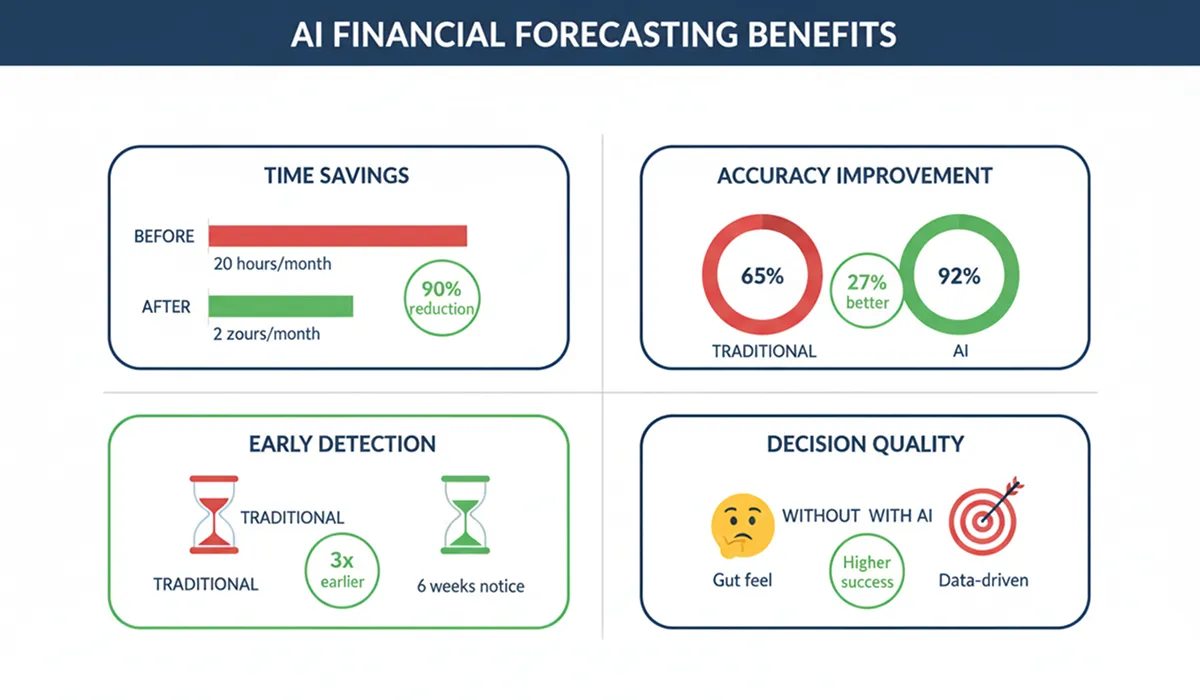
AI forecasting can reduce repetitive finance work and improve the speed of management reporting. Its value is highest when it helps the team identify a change early enough to act—for example, slower collections, rising infrastructure costs, unexpected vendor spend, or a hiring plan that materially shortens downside runway.
How much time can AI forecasting save?
Time savings depend on data quality, integrations, company complexity, and the existing finance process. Automated synchronization can reduce copying and reconciliation, while reusable scenarios reduce the need to rebuild models for every decision.
Measure savings against a baseline:
- Hours spent collecting data.
- Hours spent updating formulas.
- Hours spent reconciling actuals.
- Hours spent preparing management reports.
- Time required to answer runway questions.
Vendor-reported efficiency percentages should not be treated as universal results. Measure the effect after the first two or three forecasting cycles.
How can AI detect financial problems earlier?
An AI-assisted system can flag changes such as:
- Collections falling below the expected trend.
- Vendor spending exceeding a category threshold.
- Payroll increasing faster than the hiring plan.
- Customer churn changing materially.
- Payment processor fees rising.
- Projected cash falling below a reserve threshold.
Alerts are useful only when they are actionable. Each alert should have an owner, a threshold, and an expected response. Too many low-value alerts create noise and may cause the team to ignore important warnings.
How does forecasting improve decision quality?
A forecast makes financial trade-offs explicit. Instead of asking whether the company can afford a hire, management can ask how the hire affects runway if revenue arrives 60 or 90 days late.
A useful decision model answers:
- What changes in the base case?
- What happens if collections are delayed?
- What is the downside cash-zero date?
- Which assumptions drive most of the result?
- What trigger would cause management to change course?
Which startup decisions benefit most from AI forecasting?
AI forecasting is most valuable for recurring decisions with multiple financial consequences, such as hiring, pricing, fundraising, infrastructure spending, and collections. It is less useful when the company has almost no historical data or when the decision depends primarily on qualitative factors.
How can AI support pricing and unit economics?
A pricing model should connect price changes with conversion, churn, expansion, gross margin, and collection timing. Increasing price may improve revenue per customer while reducing conversion or increasing churn; the model should show both effects rather than assuming a direct revenue increase.
Useful unit-economic metrics include:
- Customer acquisition cost.
- Gross margin.
- Contribution margin.
- Payback period.
- Retention and churn.
- Lifetime value under defined assumptions.
David Skok’s SaaS Metrics 2.0 framework provides a widely referenced framework for analyzing SaaS economics. Its metrics are analytical tools, not universal targets that apply identically to every company.
How can AI support runway management?
AI can recalculate runway as cash, revenue, expenses, and timing change. It can compare actions such as delaying a hire, reducing discretionary spending, accelerating collections, changing payment terms, or raising capital earlier.
The output should be a decision range rather than an automated recommendation. Founders should define a minimum cash reserve and specify the actions associated with crossing each runway threshold.
Before building a rolling cash model, establish a baseline with our free startup runway calculator. It estimates net monthly burn and the cash-zero date for initial scenario planning.
How can AI support fundraising preparation?
AI can help create consistent base, upside, and downside cases from the operating model. It can also reduce the manual effort required to update investor materials when actual results change.
A fundraising forecast should clearly separate:
- Historical actuals.
- Management assumptions.
- Forecast outputs.
- Financing proceeds.
- Use of funds.
- Milestones expected before the next raise.
Model outputs should not be presented as promises. Investors evaluate the logic and credibility of assumptions as much as the precision of the spreadsheet.
How should a startup implement AI forecasting?
Implementation works best as a controlled finance process rather than a one-time software installation. Start with a narrow set of reliable data sources, validate the outputs, and establish a review cadence before adding more integrations or complexity.
What should happen during the first week?
During initial setup, the team should:
- Connect the primary bank and accounting systems.
- Import sufficient historical data for the business model.
- Map revenue and expense categories.
- Identify recurring payments and known commitments.
- Define cash reserve and runway thresholds.
- Review the first forecast against bank and accounting balances.
The goal is not to create a perfect three-year model on day one. It is to establish a trustworthy baseline that management can inspect and improve.
What should happen during the first month?
During the first month, compare forecast values with actual results at least weekly for cash and monthly for operating metrics. Resolve data issues before tuning the model. Add payroll, payment processor, billing, and CRM data only when those sources improve decision quality.
A recurring review should cover:
- Actual versus forecast cash.
- Revenue and collection variance.
- Expense variance.
- Runway change.
- New risks and planned actions.
- Assumptions that need revision.
How often should founders update the forecast?
A weekly cash review is appropriate for companies with limited runway, volatile collections, or major upcoming commitments. A monthly full-model review is usually sufficient for assumptions, operating metrics, and board reporting. The right cadence depends on risk rather than a universal calendar.
A CFO should also define who can change assumptions, how changes are documented, and when a forecast version is locked for reporting.
How should you choose an AI financial forecasting tool?
Choose a tool based on data reliability, transparency, workflow fit, security, and total cost—not on the most impressive AI label. Solo founders may prioritize speed and plain-language explanations. CFOs may need permissions, auditability, integrations, scenario controls, and board-ready reporting.
What features should a forecasting tool include?
Look for:
- Bank and accounting integrations.
- Payment, payroll, and billing connections.
- Transparent assumptions and formulas.
- Cash, burn, runway, and scenario views.
- Actual-versus-forecast variance analysis.
- Exportable reports.
- Role-based access and audit history.
- Clear data-retention and security policies.
- Support for documented manual overrides.
- A trial or low-cost entry plan.
What are warning signs in an AI forecasting product?
Be cautious if a product:
- Promises guaranteed forecast accuracy.
- Cannot explain how calculations are performed.
- Treats an LLM response as the financial model.
- Requires extensive manual data entry.
- Provides no actual-versus-forecast reporting.
- Hides pricing or integration limits.
- Has unclear security or data-retention practices.
- Does not allow management to document assumptions.
How does Uniflow compare with other approaches?
Uniflow is an AI-powered financial operating system for startups that centralizes financial data, supports cash visibility and runway planning, and helps founders and finance teams maintain a repeatable forecasting workflow. It is designed for teams that want more than a static spreadsheet while keeping management responsible for assumptions, approvals, and decisions.
| Approach | Best for | Strengths | Trade-offs |
|---|---|---|---|
| Uniflow | Solo founders and startup finance teams | Centralized financial visibility, cash and runway planning, AI-assisted insights, and a repeatable operating workflow | Requires reliable connected data and an implementation process |
| Spreadsheet model | Companies with simple structures or highly customized requirements | Flexible, familiar, and easy to modify | Manual updates, version-control risk, and limited monitoring |
| Accounting software alone | Basic bookkeeping and historical reporting | Useful source of record for transactions and accounts | Usually requires additional modeling for runway and scenarios |
| Fractional CFO or FP&A support | Teams needing judgment, planning, and investor support | Strategic context and customized analysis | Higher cost and less automation for recurring data work |
| Dedicated forecasting platform | Finance teams with complex planning needs | More advanced planning, reporting, and scenario capabilities | May require more setup, training, and budget |
What are the limitations of AI financial forecasting?
AI forecasting is not a substitute for accounting controls, a CFO, or management judgment. Its output is only as reliable as the underlying transactions, definitions, assumptions, and forecast horizon. It is weakest when a company is new, changing its business model, or facing an event with no relevant historical pattern.
Can an AI model calculate runway reliably?
A financial forecasting system should use deterministic software for arithmetic, balances, and formula-based calculations. Large language models generate probable text; they should not serve as the system of record for financial arithmetic.
The NIST AI Risk Management Framework emphasizes validity, reliability, transparency, and accountability in AI systems. In financial workflows, that means a platform should expose source data, calculation logic, assumptions, and exceptions rather than returning an unexplained number.
AI can summarize a verified forecast and identify patterns. It should not invent missing data or independently approve a high-impact financial decision.
What happens when historical data is limited?
Companies with less than three to six months of consistent data have fewer observed patterns to model. Seasonality may require a year or more of history, and a newly launched product may have no relevant historical cohort.
When history is limited:
- Use driver-based assumptions.
- Label assumptions clearly.
- Apply conservative ranges.
- Use industry benchmarks cautiously.
- Review actuals frequently.
- Avoid presenting point estimates as reliable predictions.
Can AI forecast a pivot or black swan event?
AI cannot reliably predict an unprecedented market shock, regulatory change, major pivot, or sudden customer-concentration event from historical data alone. It can quantify manually defined scenarios, but management must supply the scenario and assess its strategic plausibility.
Useful stress tests include:
- Revenue declines of 30%, 50%, or 70%.
- Collections delayed by 30 or 60 days.
- Loss of a major customer.
- Infrastructure costs doubling.
- Fundraising delayed by six months.
- An immediate hiring freeze.
When is manual forecasting better?
Manual or driver-based forecasting may be better when the company is pre-revenue, has little historical data, is changing its business model, or needs to model a decision with no historical precedent. AI becomes more useful as transaction history, customer behavior, and operating definitions become consistent.
The strongest process is hybrid:
- Software handles data synchronization and repeatable calculations.
- AI identifies patterns, summarizes variances, and proposes questions.
- Founders and CFOs set assumptions and interpret strategic context.
- Finance leaders approve the final plan and actions.
“All models are wrong, but some are useful.” — George E. P. Box, Science and Statistics (1976), American Statistical Association
The principle applies directly to startup forecasting. The objective is not perfect prediction; it is a transparent model that improves decisions under uncertainty.
What are the best practices for AI cash flow forecasting?
The core best practices are to maintain clean source data, separate actuals from assumptions, review variances regularly, use explicit scenarios, and keep humans accountable for decisions. Treat the forecast as a decision system—not as a static report produced once per quarter.
How should startups improve financial data quality?
Startups should:
- Reconcile bank and accounting balances.
- Remove duplicate transactions.
- Categorize expenses consistently.
- Separate operating and financing cash flows.
- Confirm invoice and payment dates.
- Record committed contracts and obligations.
- Document changes to revenue definitions.
Data quality is not optional. Automation can process bad data faster, but it cannot turn an incorrect transaction classification into a correct forecast.
How should teams validate AI-generated forecasts?
Validate each forecast by comparing it with actual results and investigating material variances. Do not change assumptions simply to make the forecast appear accurate. Record why an assumption changed and whether the change reflects a new fact or a management decision.
A useful review includes:
- Forecast accuracy by major category.
- Timing variance.
- Unusual transactions.
- Assumption changes.
- Downside runway.
- Actions required before the next review.
Why should startups use scenarios?
Scenarios show which variables matter most and give management predefined responses. At minimum, model changes to revenue growth, churn, collections, hiring, gross margin, and fundraising timing.
Use scenarios to answer specific questions:
- Can we hire while preserving 12 months of downside runway?
- What happens if collections slow by 45 days?
- How much capital is required if growth is delayed?
- Which expenses can be reduced without impairing core operations?
What is the future of AI financial forecasting?
The future of AI forecasting will likely combine connected financial data, deterministic modeling, natural-language interfaces, and workflow automation. The most useful systems will not merely produce a forecast; they will connect forecast changes to owners, approvals, decisions, and measurable outcomes.
Expected capabilities include:
- Asking financial questions in plain English.
- Automatic variance explanations.
- Driver-based scenario generation.
- More granular cash-collection predictions.
- Integrated investor reporting.
- Benchmarking against comparable operating patterns.
- Workflow alerts linked to specific actions.
- Stronger permissions, auditability, and model governance.
These developments may improve speed and accessibility, but they will not eliminate uncertainty. A startup forecast remains a set of assumptions about an uncertain future.
What is the conclusion about AI forecasting for startups?
AI cash flow forecasting gives solo founders and CFOs faster visibility into runway, burn, collections, expenses, and strategic trade-offs. Its value comes from reducing repetitive work and improving the speed of analysis—not from guaranteeing a correct prediction.
A practical adoption plan is:
- Establish a clean cash baseline.
- Connect the most important financial sources.
- Define revenue, expense, and runway assumptions.
- Build base, downside, and upside scenarios.
- Compare forecasts with actuals every week or month.
- Use AI for pattern detection and explanations.
- Keep humans responsible for financial decisions.
For early-stage companies, Uniflow provides an AI-powered financial operating system for organizing financial data, monitoring cash, and supporting ongoing forecasting. Explore the Uniflow financial operating system or calculate a baseline with the startup runway calculator.
Which related articles should you read next?
- Financial Operating System 101: Complete Guide
- Uniflow vs. Spreadsheets: Why Make the Switch
- Financial OS vs. Traditional FP&A
- Why Founders Fail at Financial Planning
What are the frequently asked questions about AI financial forecasting?
How accurate is AI cash flow forecasting?
Accuracy varies with data quality, forecast horizon, business maturity, seasonality, and model design. A stable company with consistent transaction history can forecast more reliably than a pre-revenue startup or a company undergoing a pivot. Evaluate tools using back-testing, variance reporting, transparent assumptions, and confidence ranges—not unsupported accuracy percentages.
How much historical data does a startup need?
Three to six months of consistent data can support an initial operating forecast, but 12 months or more is more useful for seasonal businesses. Startups with less history should use driver-based assumptions, conservative ranges, and frequent actual-versus-forecast reviews instead of treating limited historical patterns as statistically reliable.
Do founders need finance or data science expertise?
Founders do not need data science expertise, but they need enough financial understanding to define categories, validate assumptions, and interpret results. AI tools can automate data handling and explain variances in plain language. They should not replace basic financial controls, accounting oversight, or professional advice involving tax, debt, securities, or legal obligations.
Can AI forecast revenue for a SaaS startup?
AI can estimate revenue using pipeline, conversion, expansion, churn, customer cohorts, billing terms, and collections. Forecast quality depends on consistent definitions. ARR, MRR, bookings, billings, recognized revenue, and cash collected are different measures and require a clear reconciliation.
Can AI predict a startup’s cash-zero date?
AI can estimate a cash-zero date by combining opening cash, expected inflows, expenses, financing, and timing assumptions. The result is a range rather than a certainty. Founders should review the date under base and downside scenarios and maintain a minimum operating cash reserve above the modeled zero balance.
Will AI forecasting replace a CFO?
AI is more likely to automate recurring data work and improve CFO productivity than eliminate the need for financial leadership. CFOs provide judgment on strategy, capital allocation, fundraising, controls, risk, and communication with investors and the board. AI can prepare analysis, but leadership remains accountable for decisions.
How much does AI financial forecasting cost?
Pricing depends on the product, integrations, users, data volume, and support level. Some tools offer free or low-cost entry plans, while paid software and fractional finance support can range from modest monthly subscriptions to substantially higher custom fees. Confirm current pricing, integration limits, implementation costs, and contract terms directly with each provider.
Is financial data secure in an AI forecasting tool?
Security depends on the provider’s architecture and controls. Before connecting accounts, review encryption practices, access controls, data retention, subprocessors, incident response, authentication, and available independent certifications or audits. An AI label alone does not establish bank-level security or regulatory compliance.
Can AI forecast a black swan event?
No. AI can model a manually defined stress scenario, but it cannot reliably predict an unprecedented event from historical data. Use downside planning, cash reserves, financing contingencies, and explicit stress tests for events such as major customer loss, market disruption, regulatory change, or delayed fundraising.
Keywords: AI financial forecasting, financial forecasting for founders, AI-powered financial forecasting, cash flow forecasting for startups, AI for startups, financial forecasting tools, machine learning finance, predictive financial analytics
About the Author: Michael Stan is an accountant, financial advisor, and founder of Uniflow. He has spent more than a decade advising early-stage startups and building financial systems that help founders understand cash flow, runway, and growth decisions.